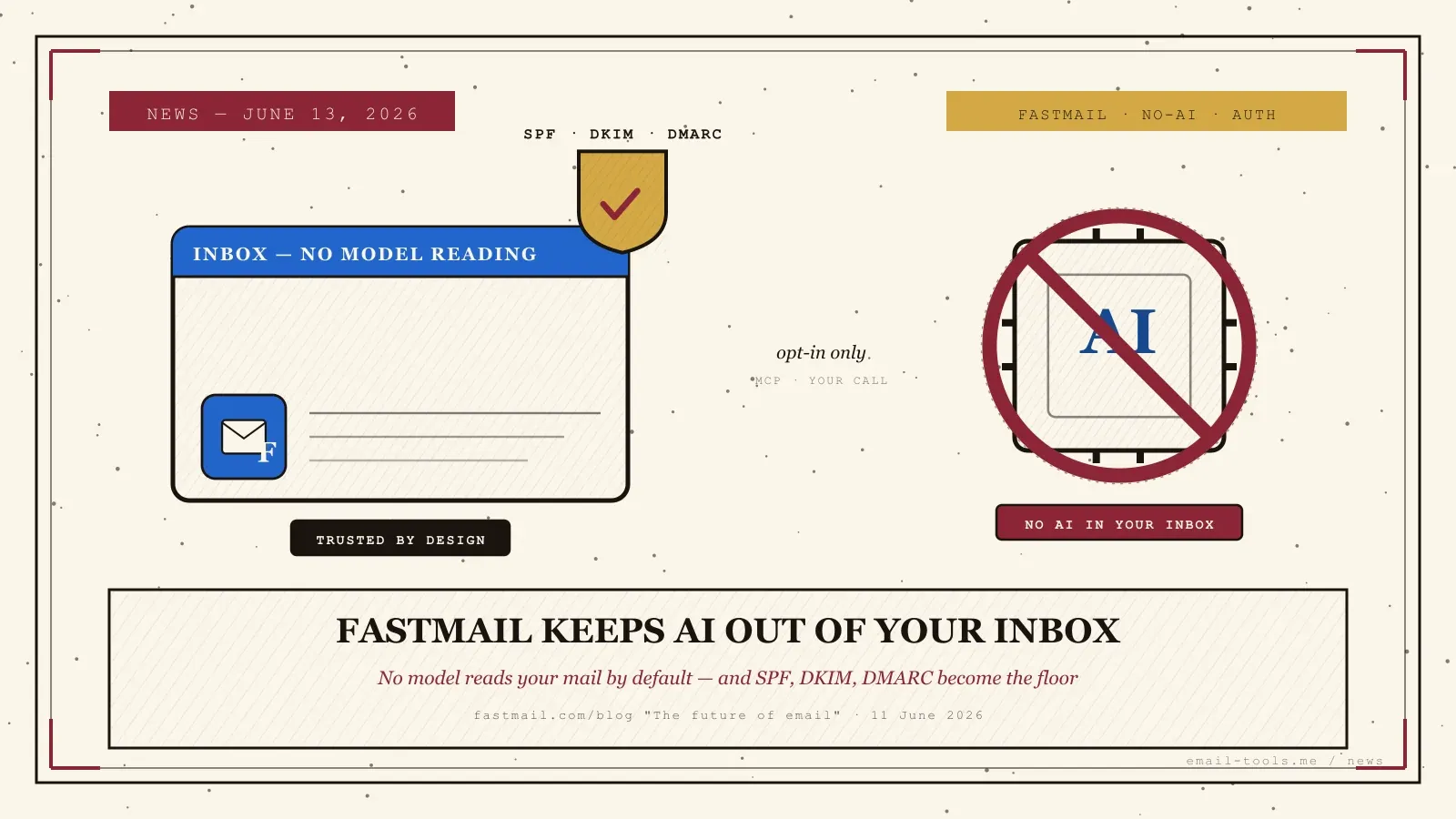
While Gmail, Apple Mail and Proton race to wire AI assistants into your inbox, one privacy-focused provider just planted a flag in the opposite direction. On June 11, 2026, Fastmail published a post titled The future of email spelling out a deliberate choice: it has not put AI inside your mailbox, and it isn’t running a model over your messages in the background. Instead it’s betting on something older and quieter — email authentication — as the foundation that actually keeps an inbox trustworthy. Here’s what Fastmail said, and why the contrarian bet matters for how you choose an email service.
What Fastmail actually said
In its June 11 post, Fastmail stated plainly that “we haven’t integrated AI into your inbox, and your mail isn’t being processed by a model in the background.” Any AI access is opt-in: the company offers an MCP server — “an API endpoint available if you want to connect an AI client of your choosing with your explicit authorization, and nothing changes if you don’t.” The default, in other words, is no AI touching your mail at all.
That stance lands in the middle of an industry sprint the other way. Google is folding Gemini 3 into Gmail with AI Overviews that summarise threads and answer questions about your inbox. Apple rebuilt Mail’s search around Apple Intelligence in iOS 27. And Google’s own Gemini Spark agent can monitor a Gmail account around the clock. Fastmail’s message to anyone uneasy about that is simple: the AI in your inbox should be a switch you flip, not a default you discover.
Why it matters for your inbox
If you care who — or what — can read your email, the default matters more than the feature list. Fastmail’s position means that unless you connect an AI client yourself, no model parses your messages. For readers weighing providers in 2026, that’s now a real axis of difference: AI-on-by-default (Gmail, increasingly Apple Mail) versus AI-only-if-you-ask (Fastmail).
The post’s second argument is less flashy but more universal. Fastmail frames email authentication — SPF, DKIM and DMARC — as having graduated “starting as a best practice, then an expectation, then infrastructure,” pointing to Google and Yahoo’s 2024 bulk-sender rules as the moment it became “a basic prerequisite for reaching inboxes.” Independent guidance agrees: all three are now effectively required for reliable delivery to Gmail, Yahoo and Microsoft, per Red Sift’s 2026 sender checklist. Looking ahead, Fastmail points to BIMI, which “lets verified senders display their logo directly in supporting inboxes,” and to lessons from the experimental ARC spec feeding a DKIM redesign for complex, forwarded mail flows.
For you, the practical read is twofold. First, if a provider’s AI handling of your mail matters to you, check the default — not the marketing — and know that at least one mainstream option keeps it off until you ask. Second, authentication is no longer an admin-only concern: it’s the layer that decides whether a message is who it claims to be, the same layer attackers tried to sidestep in last week’s Exchange spoofing flaw. Fastmail’s bet is that trust in email comes from provable identity, not a smarter assistant — and in 2026, that’s no longer a fringe position.

Alexis Dollé, email expert for 10+ years. Founder of Email Tools. I test every email client and utility myself, then write about them the way I’d explain them to a friend — no marketing fluff, no sponsored rankings, every claim sourced.
LinkedInFrequently asked questions
Did Fastmail add AI to its inbox? — no, it’s opt-in only via an MCP server
No. In its June 11, 2026 post “The future of email”, Fastmail stated it has not integrated AI into your inbox and that your mail is not being processed by a model in the background. The only AI access is opt-in: Fastmail runs an MCP server — an API endpoint you can connect an AI client to with your explicit authorization. If you do nothing, no model touches your mail.
What is Fastmail’s MCP server? — an optional API you connect an AI client to yourself
MCP (Model Context Protocol) is an open standard for letting an AI client talk to an external service. Fastmail’s MCP server is an optional API endpoint: if you choose to connect an AI assistant to your Fastmail account, you authorize it explicitly, and you can leave it disconnected. It is access on your terms rather than AI running over your inbox by default.
Why does Fastmail emphasise SPF, DKIM and DMARC? — they prove a message really comes from its claimed domain
Fastmail argues email authentication has moved “from a best practice, then an expectation, then infrastructure”, and that Google and Yahoo’s 2024 bulk-sender requirements turned it into a basic prerequisite for reaching inboxes. SPF, DKIM and DMARC are the standards that prove a message really comes from the domain it claims — the layer that decides whether a “From” line can be trusted.
How is this different from Gmail or Apple Mail? — the default is off, not on
Gmail is folding Gemini 3 into the inbox with AI Overviews that summarise threads and answer questions about your mail, and Apple rebuilt Mail’s search around Apple Intelligence in iOS 27 — both AI-forward by design. Fastmail’s distinction is the default: AI is off until you switch it on. For 2026, that’s a real choice when picking a provider — AI-on-by-default versus AI-only-if-you-ask.
What is BIMI and why does Fastmail mention it? — verified-sender logos as a visual trust signal
BIMI (Brand Indicators for Message Identification) lets verified senders display their logo directly in supporting inboxes, giving a visual trust signal that a message is genuinely from the brand it claims. Fastmail points to BIMI — and to lessons from the experimental ARC specification feeding a DKIM redesign for forwarded mail — as the next steps in making sender identity provable.
Sources
- Fastmail — “The future of email” by Aric Archebelle-Smith, published 11 June 2026 (primary: “we haven’t integrated AI into your inbox, and your mail isn’t being processed by a model in the background”; MCP server as an opt-in “API endpoint available if you want to connect an AI client of your choosing with your explicit authorization, and nothing changes if you don’t”; authentication “starting as a best practice, then an expectation, then infrastructure”, Google/Yahoo 2024 requirements as “a basic prerequisite for reaching inboxes”; BIMI “lets verified senders display their logo directly in supporting inboxes”; ARC informing a DKIM redesign for complex flows)
- Google — “Gmail launches AI features like AI Overviews and more, made possible by Gemini 3”, 8 January 2026 (contrast: Gemini 3 in Gmail; AI Overviews summarise threads and answer inbox questions; some features on by default)
- 9to5Mac — “iOS 27 gives Apple Mail my most wished-for feature upgrade”, 11 June 2026 (contrast: Apple rebuilt Mail’s search index around Apple Intelligence in iOS 27)
- Red Sift — “2026 bulk email sender requirements checklist: Microsoft, Google, and Yahoo compliance guide” (independent corroboration: SPF, DKIM and DMARC now required for reliable inbox placement at Gmail, Yahoo and Microsoft)