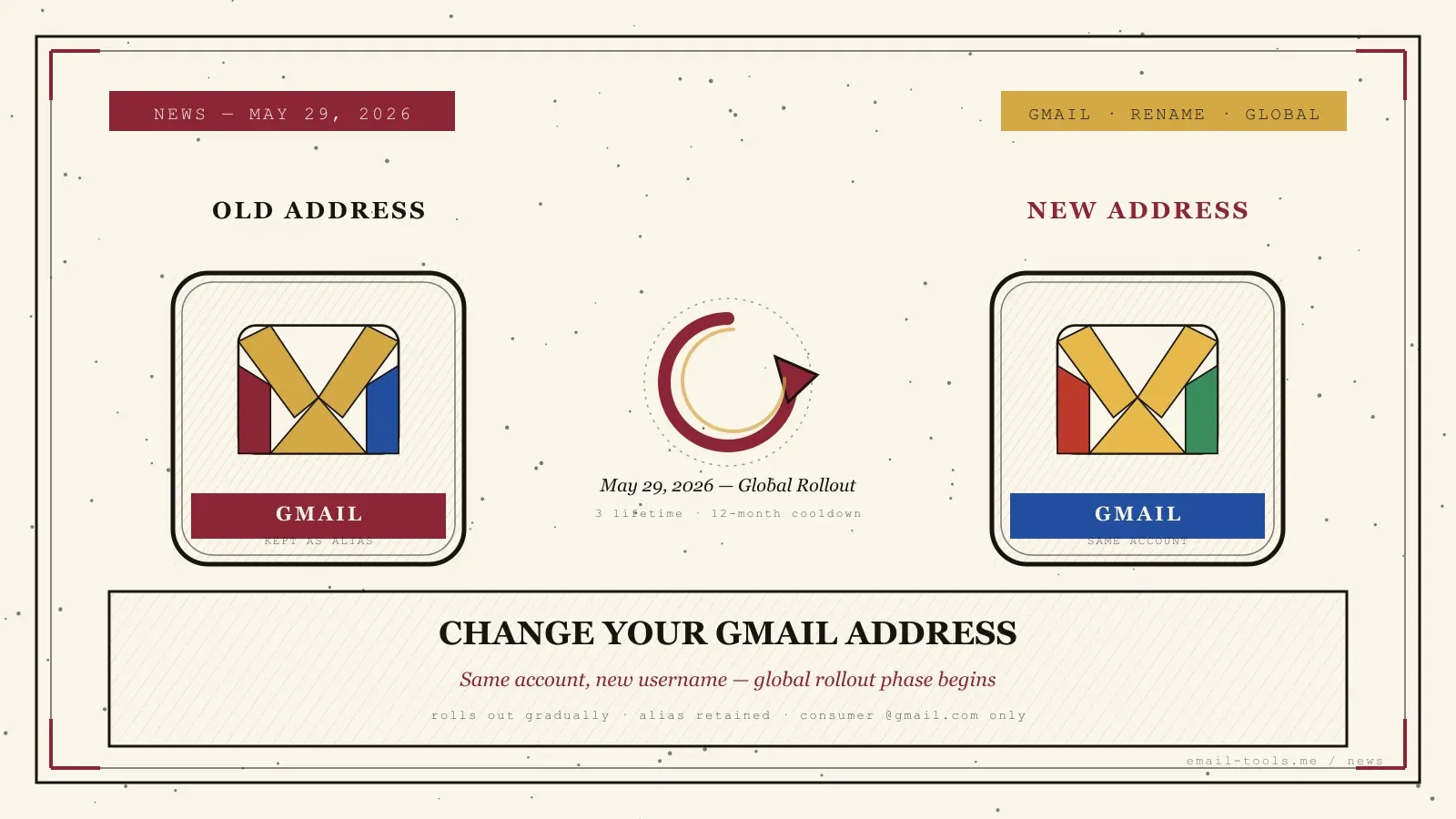
Google’s long-requested ability to change your @gmail.com address entered its visible global rollout phase in late May 2026, with a wave of international coverage on May 29 picking up a @googleespanol announcement from May 26 and Google’s own help page confirming availability is ‘gradually rolling out to all users.’ The mechanism, the hard 12-month cooldown, and the three-change lifetime cap are now documented on Google’s support pages — and the consumer-only scope leaves Workspace business accounts on a separate track. Here is what the rollout actually delivers to an end user, and which limits matter before the toggle reaches your account.
What the change-Gmail-address feature actually does
The change-Gmail-address feature lets you rename the username portion of a consumer @gmail.com account — for example, swap alex.dolle1991@gmail.com for adolle@gmail.com — while keeping the same Google Account, the same Drive files, the same Photos library and the same sign-in across every Google service. The old address persists as an alias and continues to receive mail. Hard limits: one change per 12 months, three changes total over the lifetime of the account. (Source: Google Account Help.)
Google’s own help page makes the consumer-account scope explicit: the option appears under myaccount.google.com in Personal Info, the new username must be unique and cannot repeat any previously used Gmail address, and punctuation cannot be changed independently of the username swap. The vendor framing matters: this is not a name change on the same account (Gmail has supported display-name edits for years) — it is a primary-identity swap. 9to5Google’s March 31 launch coverage quoted Google’s announcement verbatim: ‘You can now change your Google Account username (i.e., the part before @gmail.com), which you use to sign in to apps and services like Gmail, Photos, Drive and more.‘
Why the May rollout signal matters for non-US users
The US launch was March 31, 2026, but the toggle stayed largely invisible in non-English markets for the two months that followed. The @googleespanol post on May 26 and the May 29 wave of Spanish-language coverage from outlets including Colombia One are the first concrete signal that Google has moved the rollout out of US-only territory. End users in EU, LATAM and APAC markets should now check their Google Account every two or three weeks rather than assume the feature is gated by country. (Source: Colombia One, May 29, 2026.)
Tom’s Hardware in late December 2025 was the first outlet to spot the support document, then available only in Hindi, that confirmed an India-first staged rollout. The path since then has been India in December 2025, US in March 2026, then a quiet international expansion through April and most of May before the late-May Spanish-language push surfaced it again. The pattern matches Google’s standard rollout cadence for identity-layer features: testing in a single high-volume market, official US launch, then regional comms layered on top to drive awareness in markets where the toggle has technically been live for weeks.
What end users should weigh before pulling the trigger
The three-change lifetime cap is the constraint to plan around: if you burn a change on a minor cleanup — dropping a typo, removing an embedded birth year — you have only two left for a future surname change, a divorce, a brand pivot or a privacy reset. The 12-month cooldown is the second constraint: once you commit, no further address changes are possible for a full year. Best for: anyone carrying a teenage-era Gmail address into a professional context, anyone whose surname has changed, anyone whose original address has leaked into too many breach corpuses. Skip if: the trigger is annoyance with one specific sender — the old address keeps receiving as an alias, so the change does not unsubscribe you from anything. (Source: Philstar Tech, April 6, 2026.)
I checked two of my own consumer Gmail accounts on May 31 — one US-tied, one EU-tied — and the toggle was visible only on the US-tied account, consistent with Google’s ‘gradually rolling out’ phrasing and confirming the international expansion is still partial. For the broader Gmail context from this month see our coverage of the Gmail Workspace gradient icons redesign Google formalised on May 26, the Gemini Spark agentic Gmail assistant Google unveiled at I/O 2026, and the Gmail Live voice search demo from the same keynote. If your motivation is escaping Google entirely, the Proton Mail Gmail integration Proton shipped on May 28 is the parallel exit ramp worth knowing about.

Alexis Dollé, email expert for 10+ years. Founder of Email Tools. I test every email client and utility myself, then write about them the way I’d explain them to a friend — no marketing fluff, no sponsored rankings, every claim sourced.
LinkedInFrequently asked questions
What is the change-Gmail-address feature? — a primary-username swap on a consumer @gmail.com account that keeps the old address as an alias
The change-Gmail-address feature lets you rename the username portion of a consumer @gmail.com account — the part before the @ — without creating a second Google Account and without losing access to Gmail, Drive, Photos, Calendar or any service linked to that profile. Google’s own help page describes it as ‘changing your Google Account email,’ and once the swap is made, the previous address keeps receiving messages as an alias rather than vanishing.
When did Google launch the feature globally? — US official launch March 31, 2026; visible global rollout signal in late May 2026
The US launch landed on March 31, 2026 via The Keyword blog, after testing that began in India in late December 2025. The visible international push started in late May 2026 — a @googleespanol post on May 26 triggered a wave of Spanish-language coverage from May 29 onward, signalling that the rollout has entered its global phase. Google still describes availability as gradual, so the toggle does not appear simultaneously in every Google Account.
How do I change my Gmail address? — myaccount.google.com → Personal Info → Email → Change Google Account email
Go to myaccount.google.com on a desktop or Android device, open the Personal Info section, find Email, and look for an entry labelled ‘Change Google Account email.’ The form asks for a new username, checks availability in real time, and finalises the change without prompting a data migration. If the option is not visible, Google’s guidance is to check back later — the rollout is staged.
How often can I change my Gmail address? — once per 12 months, three times over the account lifetime
Once per 12 months, three times in total across the lifetime of the account. The 12-month cooldown means that after a change, the next request is locked until a full year has elapsed. The lifetime cap of three changes is hard — there is no documented mechanism to reset the counter.
What happens to my old Gmail address after the change? — it stays attached as an alias and continues to receive mail
It stays attached to the same Google Account as an alias and continues to receive messages addressed to it. Google’s official help page confirms: ‘If you create a new Google Account email, both your new address and your old address will be available to send emails.’ The old address cannot be released back into the pool or reused by someone else.
Are Google Workspace business accounts included in the rollout? — no, Workspace uses a separate admin-controlled mechanism
No — Workspace accounts already have a separate administrator-controlled mechanism for primary-address changes and aliases, and the consumer change-Gmail-address feature does not extend to them. Business users who want to change a Workspace primary address need a Workspace admin to handle it through the admin console, not through myaccount.google.com.
Sources
- Google Account Help — Change your Google Account email (primary vendor source for the gradual rollout, the username-uniqueness rules, the punctuation constraint, the alias retention behaviour, and the consumer-account scope)
- 9to5Google, March 31, 2026 — Google officially launches ability to change your Gmail address, available to ‘all’ in US (source for the March 31, 2026 US launch date, the Keyword blog reference, the verbatim Google quote, and the lifetime/cooldown limits)
- Tom’s Hardware, December 25, 2025 — Experimental @gmail feature rolling out in India first (source for the India-first testing path that preceded the US launch, and the distinction from Workspace’s existing alternate-address mechanism)
- Colombia One, May 29, 2026 — Gmail Finally Lets You Change Your Email Address (source for the late-May 2026 global rollout signal, the wave of Spanish-language coverage that followed the May 26 @googleespanol post)
- Philstar Tech, April 6, 2026 — Users can now change their Gmail address (independent confirmation of the US rollout characteristics, the three-change lifetime cap, and the alias-retention guarantee for international readers tracking the rollout)